✧✧✧✧✧>Animal Profiles - An A to Z List of Animal Groups <✧✧✧✧✧
|
|
The first link below is a site that lists the animal groups and their classification. It is an index to animal profiles and fact sheets. The kingdom, phylum, class, sub-class and order are listed with the description of each animal group. The groups include amphibians, birds, fish, invertebrates, mammals, reptiles and higher level groups. The site includes links to other animal information pages.
A to Z Listing of Animal Groups - http://animals.about.com/od/zoology12/a/atozgroups.htm Animal Groups, Facts, Articles, Quizzes ect. - Family Friendly - http://www.sheppardsoftware.com/web_games_trivia_ animal.htm NatureServe Explorer - An Online Encyclopedia of Life http://www.natureserve.org/explorer/ |
❧❧❧❧❧❧ A to Z of Plants by Joy of Plants ❧❧❧❧❧❧
|
|
The first link below is an online database that lists some 7,400 plant species with many photos included. The common and scientific names are included. You can search the database by botanical name, ect. The Plant Finder's database will also search according to group, color, plant type, size and plant uses. This means that you can choose the common name, botanical name, type of plant and its features when searching for a species. Try to be more specific when searching the database.
Joy of Plants - A to Z Listing of Plants http://www.joyofplants.com/plantfinder.php USDA - Plants Database http://plants.usda.gov/java/ Plant Files by Dave's Garden http://davesgarden.com/guides/pf/ |
❁❁❁❁❁❁❁❁❁ American Mushrooms + ❁❁❁❁❁❁❁❁
|
^ Note - Some mushrooms are in other countries. ^
|
There are over 10,000 species of mushrooms just in North America. Around 250 are edible. Mushrooms come in all colors, various shapes and sizes which are seen all over the world. Below are three links to mushroom sites. David Fischer's American Mushrooms site has photos and all kinds of information on mushrooms. He has links and identification help as well. Over 1000 photos of mushrooms are on the site. The NAMA site has various resources including links, clubs, events, education, toxicology and even photography. Roger's Mushrooms has information and photos as well.
Dave Fischer's American Mushrooms http://americanmushrooms.com/basics.htm NAMA http://www.namyco.org Roger’s Mushrooms http://www.rogersmushrooms.com/ |
✴️✴️ Glow-in-the-dark Mushroom Rediscovered After 170 Years ✴️✴️ Photo - Glow-in-the-dark Mushroom ( Panellus stipticus )
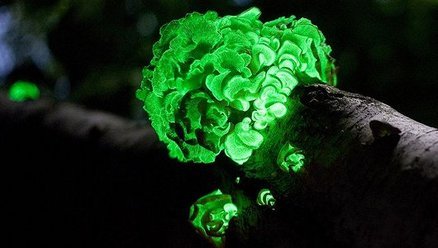
Spotted once in 1840 and then never seen again, one of the world's most bioluminescent mushrooms has been rediscovered deep in the Brazilian wilderness. It's something you would never expect to go missing, but one of the world's brightest glow-in-the-dark mushrooms has been rediscovered after an absence of more than 170 years, according to USA Today.
The bioluminescent shrooms had become a Brazilian legend of sorts. They were first spied in 1840 by an English botanist named George Gardner, who was alarmed after he saw some boys playing with a glowing object in the streets of Vila de Natividad, a village in the Goiás state in central Brazil. After that, no more sightings of the brightly glowing fungus had ever been reported. The mushroom was nearly forgotten until 2002, when Brazilian chemist Cassius Stevani came across Gardner's early reports. Then, in 2005, a breakthrough occurred. A pair of primatologists, Patricia Izar from São Paulo University in Brazil and Dorothy Fragaszy of the University of Georgia in Athens, were studying a band of monkeys deep in the Brazilian interior when they came across something mysterious glowing at the base of some palm trees. Izar and Fragaszy scooped up specimens and contacted Stevani, who later confirmed that the mushrooms were indeed Gardner's long lost species. The findings are what led to this month's paper in the journal Mycologia. Ironically, right after the rediscovery of the mushrooms, scientists came to learn that local people were quite familiar with them. In fact, the mushrooms had a common name, flor-de-coco, or flower of the coconut, since it is commonly found on the rotting fronts of dwarf palm trees. As is often the case, scientists had just never bothered to ask.
Although glowing fungi are nothing new to science — there are 71 identified species — this particular species (named Neonothopanus gardneri, after the initial discoverer) is notable for its size and the extraordinary strength of its light. "It glows more brightly than almost all other luminescent mushrooms," said Dennis Desjardin, a fungi expert at San Francisco State University. "If you were in a dark room and you put one on a newspaper, you'd be able to read the words." Desjardin also noted that these mushrooms can grow up to three inches in diameter, which is giant compared to most bioluminescent fungi.
Stevani is currently working to identify the chemical pathways that allow these mushrooms to produce light, a system that remain a mystery to science. As for why they glow, scientists still aren't sure why it happens. One theory suggests that the mushrooms may glow to attract insects that help to spread their spores. Another theory, also involving the attraction of insects, proposes that the light is a beacon to predatory bugs that feed on insects that threaten the fungus. One thing researchers are certain of, however, is that these mushrooms are poisonous. So while the mushrooms' glow-in-the-dark properties may be interesting to people, researchers strongly advise that they shouldn't be eaten.
^^^^^^^^^^^^^^^^^^^^^^^^^^^^^^^^^^^^^^^^
The bioluminescent shrooms had become a Brazilian legend of sorts. They were first spied in 1840 by an English botanist named George Gardner, who was alarmed after he saw some boys playing with a glowing object in the streets of Vila de Natividad, a village in the Goiás state in central Brazil. After that, no more sightings of the brightly glowing fungus had ever been reported. The mushroom was nearly forgotten until 2002, when Brazilian chemist Cassius Stevani came across Gardner's early reports. Then, in 2005, a breakthrough occurred. A pair of primatologists, Patricia Izar from São Paulo University in Brazil and Dorothy Fragaszy of the University of Georgia in Athens, were studying a band of monkeys deep in the Brazilian interior when they came across something mysterious glowing at the base of some palm trees. Izar and Fragaszy scooped up specimens and contacted Stevani, who later confirmed that the mushrooms were indeed Gardner's long lost species. The findings are what led to this month's paper in the journal Mycologia. Ironically, right after the rediscovery of the mushrooms, scientists came to learn that local people were quite familiar with them. In fact, the mushrooms had a common name, flor-de-coco, or flower of the coconut, since it is commonly found on the rotting fronts of dwarf palm trees. As is often the case, scientists had just never bothered to ask.
Although glowing fungi are nothing new to science — there are 71 identified species — this particular species (named Neonothopanus gardneri, after the initial discoverer) is notable for its size and the extraordinary strength of its light. "It glows more brightly than almost all other luminescent mushrooms," said Dennis Desjardin, a fungi expert at San Francisco State University. "If you were in a dark room and you put one on a newspaper, you'd be able to read the words." Desjardin also noted that these mushrooms can grow up to three inches in diameter, which is giant compared to most bioluminescent fungi.
Stevani is currently working to identify the chemical pathways that allow these mushrooms to produce light, a system that remain a mystery to science. As for why they glow, scientists still aren't sure why it happens. One theory suggests that the mushrooms may glow to attract insects that help to spread their spores. Another theory, also involving the attraction of insects, proposes that the light is a beacon to predatory bugs that feed on insects that threaten the fungus. One thing researchers are certain of, however, is that these mushrooms are poisonous. So while the mushrooms' glow-in-the-dark properties may be interesting to people, researchers strongly advise that they shouldn't be eaten.
^^^^^^^^^^^^^^^^^^^^^^^^^^^^^^^^^^^^^^^^
